Recent Updates on AbkhazWorld.com
Translations by AW

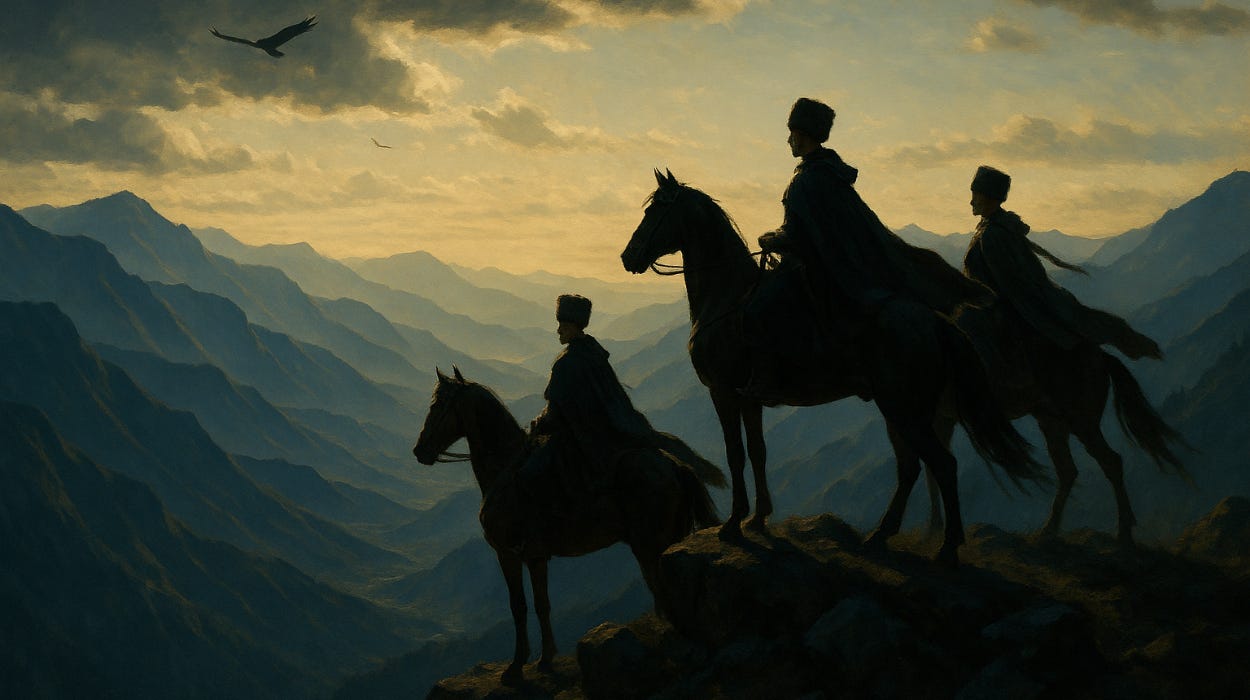
Vainakhs, Alans and Adyghes in the 6th–8th Centuries, by Zurab Anchabadze / Achba
Z. V. Anchabadze
Essays on the History of the Peoples of the North Caucasus in the Middle Ages
Part I (6th–8th centuries)
Tbilisi, 1982 (pp. 325–336).
Problems of the History of Abkhazia in the Soviet Period in the Works of Zurab Anchabadze, by Arvelod E. Kuprava
Questions of the History of the Peoples of the Caucasus
(collection of articles dedicated to the memory of Z[urab].V. Anchabadze)
Tbilisi, 1988 (pp.42-48)
Konstantin Shakryl and Issues of the National Liberation Movement of the Abkhaz People, by Aslan Avidzba
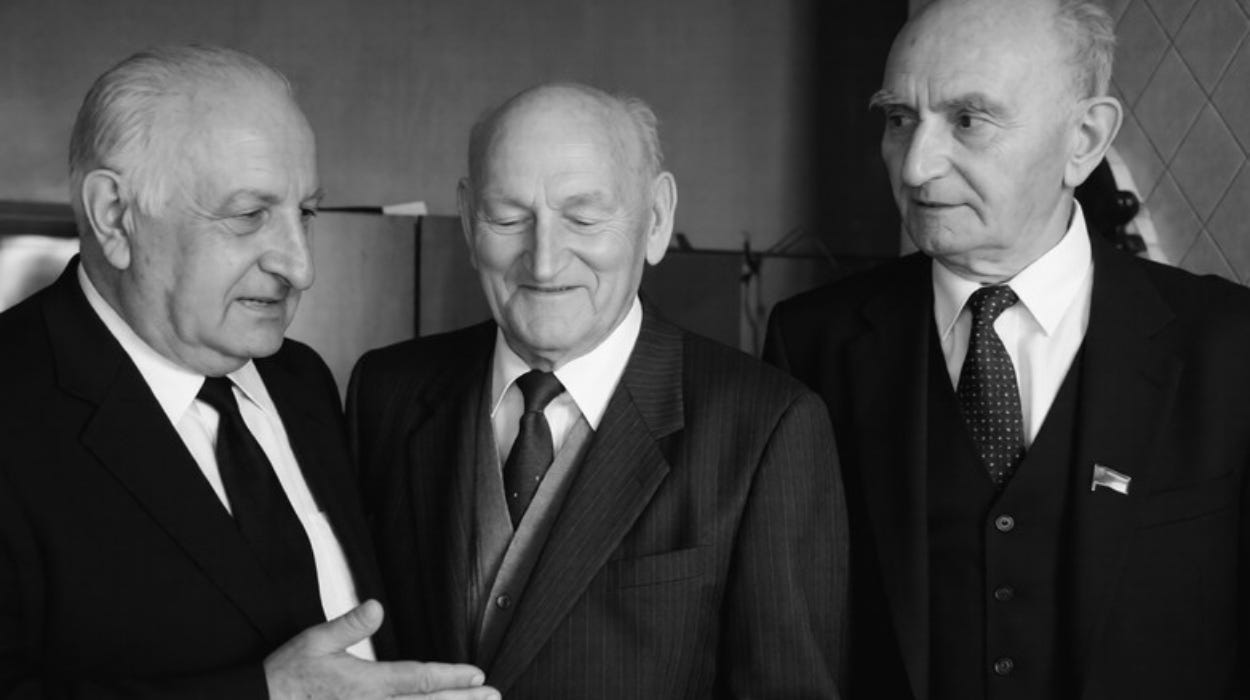
Aslan F. Avidzba
Doctor of Historical Sciences,
Deputy Director,
D. I. Gulia Abkhazian Institute of Humanitarian Researchstitute of Humanitarian Research,
Sukhum, Abkhazia
Abstract
The article explores issues connected with the national liberation movement of the Abkhaz people. The author discusses the cultural and linguistic transformations in Abkhazia which led to catastrophic consequences for the Abkhaz people, particularly in the sphere of school instruction, as well as the resulting obstacles to the development of an Abkhaz intelligentsia and the loss of national and cultural identity among young people. The study also addresses the resettlement of Greeks, Turks and other populations, and the settlement of Georgians in their place, as well as the repressions directed against peoples living on the territory of Abkhazia.
The article examines the notion of “Abkhaz letters” as an integral element of the national liberation movement of the Abkhaz people in the twentieth century. Special attention is devoted to the first letter, written by K[onstantin]. Shakryl, B[agrat]. Shinkuba and G[eorgy]. Dzidzaria. When they sent it in 1947 to Moscow, to the Central Committee of the All-Union Communist Party (Bolsheviks), setting out the oppression suffered by the Abkhaz people, they understood that they were in effect signing their own sentence and condemning themselves to repression; nevertheless, they took this step. The article describes their subsequent fate and the hardships they were compelled to face.
Abkhazians and the Sea, by Otar P. Dzidzaria (Dzari-ipa)
Against the background of the traditional way of life of the mountain peoples of the Caucasus, which has remained stable over several millennia, a special place undoubtedly belongs to the Abkhazians, whose area of settlement was fixed along the eastern coast of the Black Sea. (Among all the indigenous populations of the Caucasus, a similar specificity of life is revealed, apparently, only among the Laz,¹ whose historical fate also turned out to be closely bound up with the sea.) It is appropriate to mention that the Black Sea itself was sometimes called the Abaz Sea, that is, the Abkhaz Sea.²
Abkhaz mythology, folklore and language have preserved numerous testimonies to the close economic dependence of their life on the sea, which until very recently have only begun to be drawn into the orbit of serious research. One of the most striking pieces of evidence of this kind has been preserved in the active vocabulary of the people. The material basis of the present study, naturally, depended to a certain extent on the representation of maritime vocabulary (and, in particular, the corresponding terminology) in lexicographical collections of the Abkhaz language. However, in the course of work a quite obvious incompleteness of the latter, in the respect that concerns us, was revealed.
Pantheon of the Abkhazian Gods: An Attempt at Systematisation, by Valery Biguaa
Biguaa, V. (2023) Анцвахацара-Ancvaxacara: The Abkhaz Traditional Religion. Sukhum: Abkhaz State University, pp. 22–34.
‘According to Abkhaz mytho-poetic conceptions, the cosmos had a beginning. Yet … the universe is not conceived as a fixed or immutable magnitude’ (Zukhba, 1995: 32). This suggests that since the universe / world (адунеи – адуней / adunei, adunej) has a beginning, it must also have an end.
The universe / world is understood as a boundless, living expanse, both vertically and horizontally. Vertically, the cosmos is imagined as a tripartite structure (адунеи хԥаны еихагылоуп): ахы (axə) – the ‘head’; аҵыхәа (ačyx°a) – the ‘tail’; and агәы (ag’ə) – the ‘heart’. Taken literally, these denote ‘head’, ‘tail’, and ‘heart’, yet cosmologically they refer respectively to the upper realm, the sky (ажәҩан – ажвюан / až’w’an), the lower realm or underworld (ахәоу аҵа – адгыл аца / adg’əl aça), and the middle world, the earth itself (аркны – адгыл / adg’əl). Each realm is simultaneously an integral part of the whole and a self-contained entity, imagined as a seven-layered being.
What Does the Trabzon–Sochi Ferry Mean for the Caucasus? By Jade Cemre Erciyes
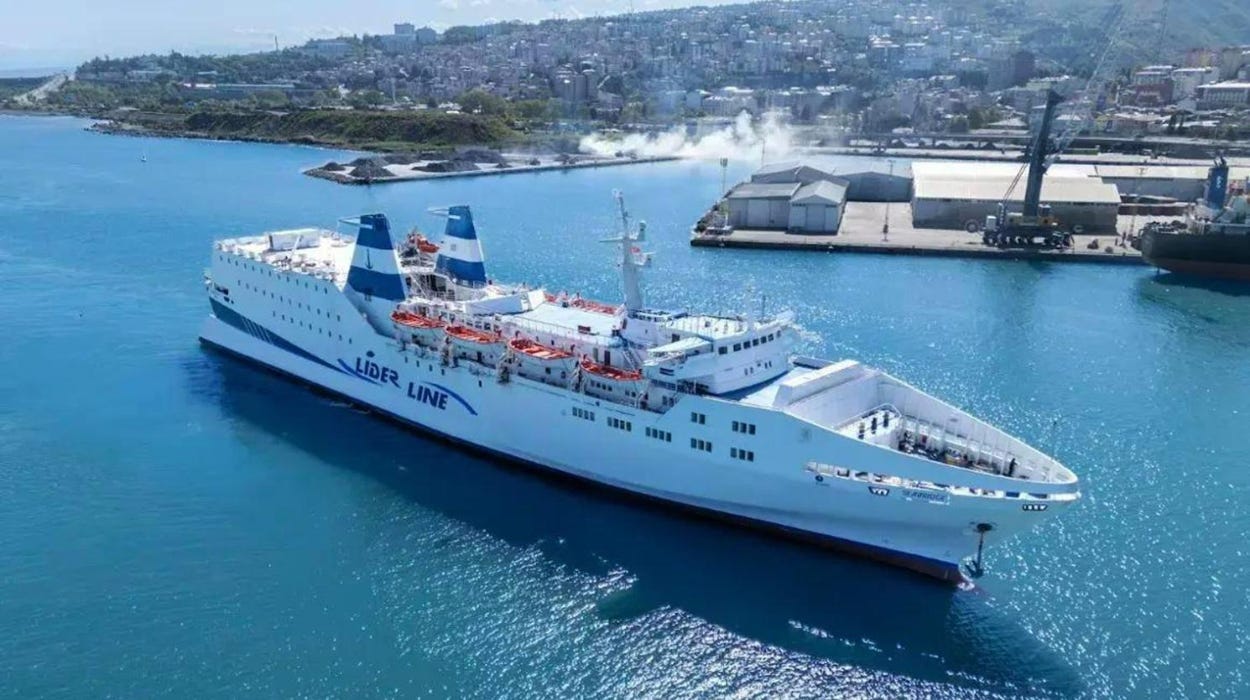
In today’s world, speed in transportation is prized above all. You board a plane and reach your destination within a few hours. Yet there was a time when flights were prohibitively expensive, and sea and land routes played an essential role in travel.
For Circassians, journeys across the Black Sea are almost always associated with stories and trauma. In Bagrat Shinkuba’s novel The Last of the Departed, in the story behind the lament “Shish Nane” a woman sings to her dying infant about the homeland they have left behind, hoping no one will notice the child has passed away. But when Turkish fishermen, sensing death, tear the child from her arms and throw him into the sea, the mother leaps after him. Her story has long since become the shared story of all families marked by the Caucasian Exile.
New President Elected to Lead the Federation of Abkhaz Cultural Centres in Türkiye
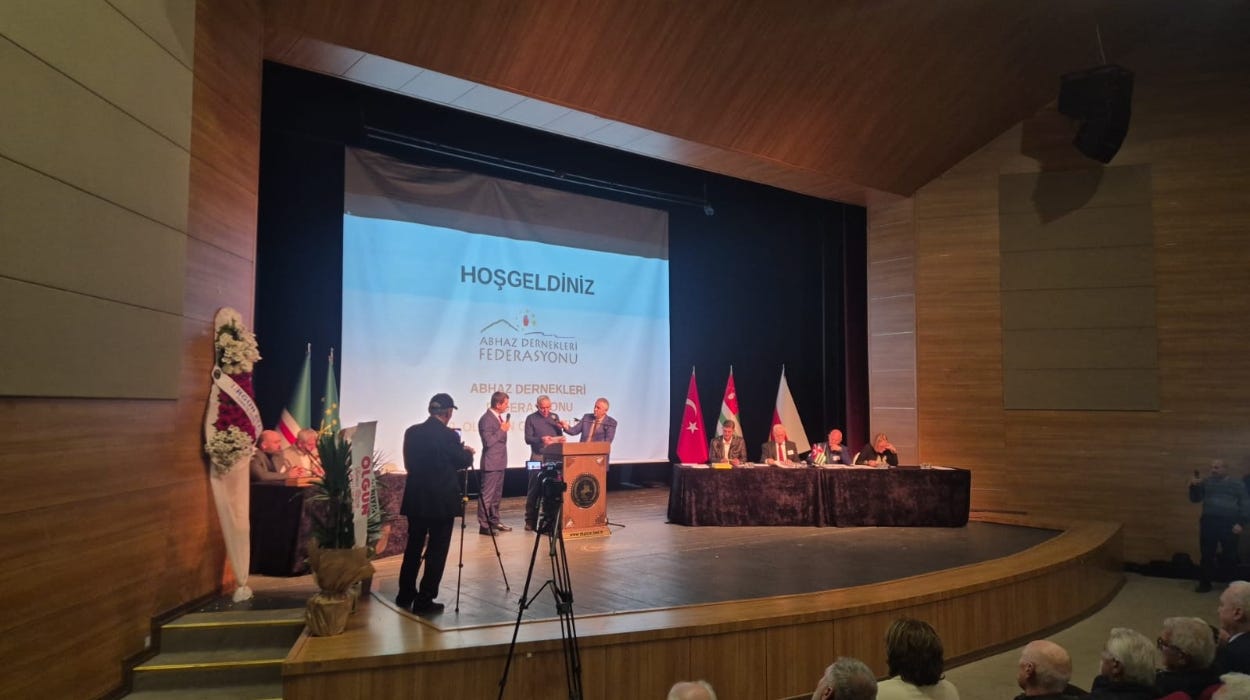
The Federation of Abkhaz Cultural Centres in Türkiye (ABHAZFED) has elected a new president during its 14th Congress, held on 23 November in Düzce. Delegates reviewed a comprehensive report on the organisation’s recent work before proceeding to a key leadership vote.
Two candidates stood for the presidency: Elif Marshan and Yavuz Atrishba. In the ballot, a majority of the 333 delegates voted for Yavuz Atrishba, a veteran of the 1992–1993 Georgian–Abkhaz War (Patriotic War of the People of Abkhazia), electing him as the Federation’s new president.
Abkhazia’s President, Badra Gunba, telephoned Atrishba to congratulate him on his election, extending his best wishes for the term ahead. “When Abkhazia was in danger, you stood by your brothers and defended your homeland with arms,” the President said. “I am confident that you will achieve great success as President of the Federation of Abkhaz Associations.”
President Gunba also spoke with the other candidate, Elif Tapsh (Marşan), thanking her for her service and commitment. “The Abkhazians living in Abkhazia, in Türkiye, and in other countries are one people,” he stressed. “We work shoulder to shoulder for the development of the country and the preservation of our language and national identity.” He extended an invitation to both Atrishba and Marşan to visit Abkhazia.
AW on X: www.x.com/AbkhazWorld
AW on Facebook: www.facebook.com/AbkhazWorld
AW on YouTube: www.youtube.com/AbkhazWorld
AW on Telegram: https://t.me/AbkhazWorld
AW on SoundCloud: www.soundcloud.com/AbkhazWorld
Make a donation today to support the work of AbkhazWorld and help us continue our projects.
You can support our work with a one-time donation or monthly subscription.
PayPal: https://www.paypal.com/donate/?hosted_button_id=KZMKPDZHLYVDA
PayPal email: abkhazworld@gmail.com
Subscribe Substack: